A remote patient monitoring platform that connects patients with their doctors, enabling communication and continuous monitoring outside of traditional healthcare settings. The core goal is to reduce hospital readmissions by using AI and predictive models to detect early signs of exacerbation and risk.
Problem Statement
Nurses and doctors were managing high-risk COPD patients using fragmented information spread across EHRs, device exports, and phone notes. They lacked a single, real-time view of who was deteriorating and why, forcing them into reactive care instead of catching gradual decline early.
The Solution
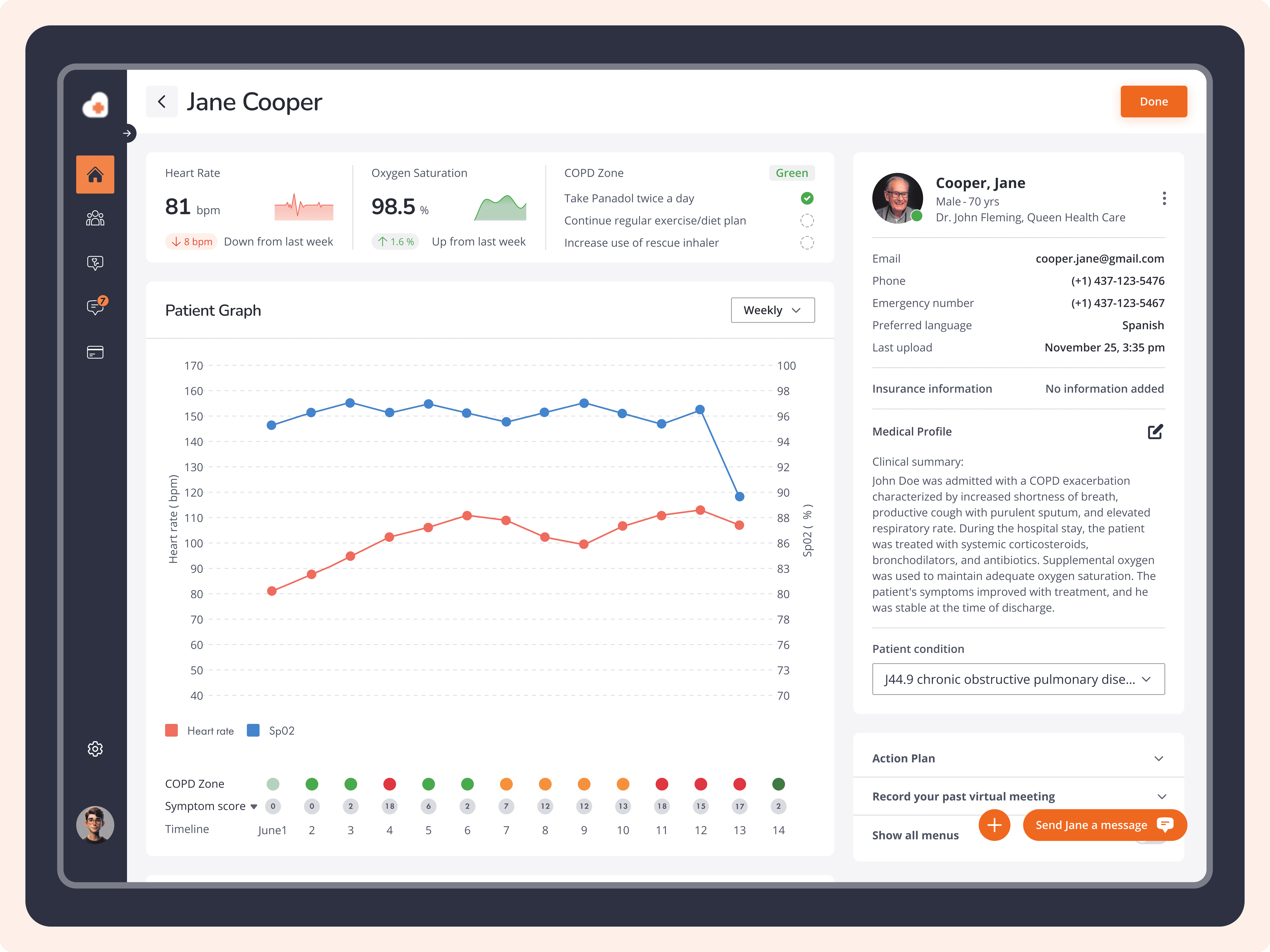
I designed a clinician-only web dashboard that brings COPD monitoring into one focused, actionable view. The dashboard surfaces AI-driven risk levels, recent symptom and vital trends, and clear alerts across the patient population. Clinicians can quickly scan, drill into a patient’s history, understand why risk is rising, and document outreach—supporting earlier interventions and more confident, proactive care.
My Role
As the sole UX/UI Designer at Tabiat, I led the end-to-end design of an AI-powered COPD remote monitoring platform. I worked directly with founders, nurses, doctors, and data scientists to define the product vision and translate clinical needs into clear workflows. I designed a clinician-only web dashboard for nurses and doctors, and a dedicated mobile app for patients, owning research, information architecture, user flows, wireframes, and high-fidelity UI through to handoff.
The Challenge
This project surfaced three core challenges:
1. Unifying fragmented COPD data for clinicians
Nurses and doctors were jumping between EHRs, wearable exports, patient calls, and spreadsheets. Nothing gave them a real-time, centralized view of patient deterioration.
Our challenge was to design a clinical dashboard that pulls everything together—symptoms, vitals, trends, and AI risk predictions—into one clear, actionable workflow.
2. Designing AI insights clinicians trust
Predictive models can be powerful, but only when care teams understand why a patient is flagged. We needed to structure AI insights so they felt transparent, medically relevant, and safe to act on.
3. Creating a supportive, easy-to-use experience for patients
COPD patients often deal with anxiety, low mobility, and multiple comorbidities. The patient mobile app had to feel simple, encouraging, and non-intimidating—while still collecting enough data for clinicians to spot early declines.

Process & Approach
Understanding the Care Teams (Primary Target Users)
I conducted interviews and task analysis with:
Pulmonologists
Respiratory nurses
Care coordinators
This helped us map their day-to-day decision-making: triaging risk, reviewing symptom trends, choosing outreach timing, and documenting follow-ups.
From this, we identified what mattered most:
Fast identification of high-risk patients
Clear, uncluttered visuals
Trends that feel medically meaningful
Click-saving workflows for busy clinicians

Ethical AI & Trust-Centric Clinical Design
For clinicians, I focused on:
Explainable risk signals: Breaking down AI predictions into contributing factors like persistent breathlessness, activity decline, or low SpO₂.
Clear urgency levels: “Monitor,” “Review Today,” and “Urgent—Contact Patient.”
Confidence-building visuals: Trend charts that highlight meaningful changes without overwhelming the user.
For patients, I ensured:
Transparent explanations of what data is collected
Opt-in control for wearable syncing
Non-judgmental language and calm visual cues
Our goal was simple: create tools that feel safe, supportive, and clinically credible.
Designing for Both Sides of the Care Loop
Clinical Dashboard (Nurses + Doctors)
Built to support fast, informed decisions:
Prioritized patient list based on AI risk
Quick-glance trend visualizations
One-click access to recent events
Structured documentation to support outreach
Modular components scalable for future conditions
Patient Mobile App
Designed to reduce friction and increase reporting reliability:
Simple daily symptom check-ins
Seamless wearable integration
Gentle reminders instead of anxiety-inducing alerts
A clean, high-contrast layout suitable for older users
This two-sided system helped close the loop—patients collect data passively or through check-ins, and clinicians respond early through a unified dashboard.
Collaboration with Founders & Cross-Functional Teams
I worked closely with:
Founders and clinical advisors to craft the care model
Engineering to ensure feasibility and smooth integrations
I presented iterations regularly and used real patient scenarios to demonstrate how the platform supports early intervention.
Impact & Key Learnings
✨ 1. Continuous monitoring transforms care
Clinicians finally had a live view of their COPD population—ending the cycle of missed warning signs and crisis-driven care.
✨ 2. Trustworthy AI must feel simple
Clarity beats complexity. Care teams embraced the dashboard because it respected their clinical intuition rather than trying to replace it.
✨ 3. Patient engagement grows when the experience feels supportive
Older COPD patients responded well to calm, simple interfaces and encouraging guidance rather than alarming alerts.